When Keeping Someone with Dementia at Home Isn't Always the Most Loving Choice
Sometimes loving someone means recognising when they need more support than you can provide at home. Explore how residential care can support safety, wellbeing and dignity while allowing families to continue being present in meaningful ways.
Sep 18, 2026
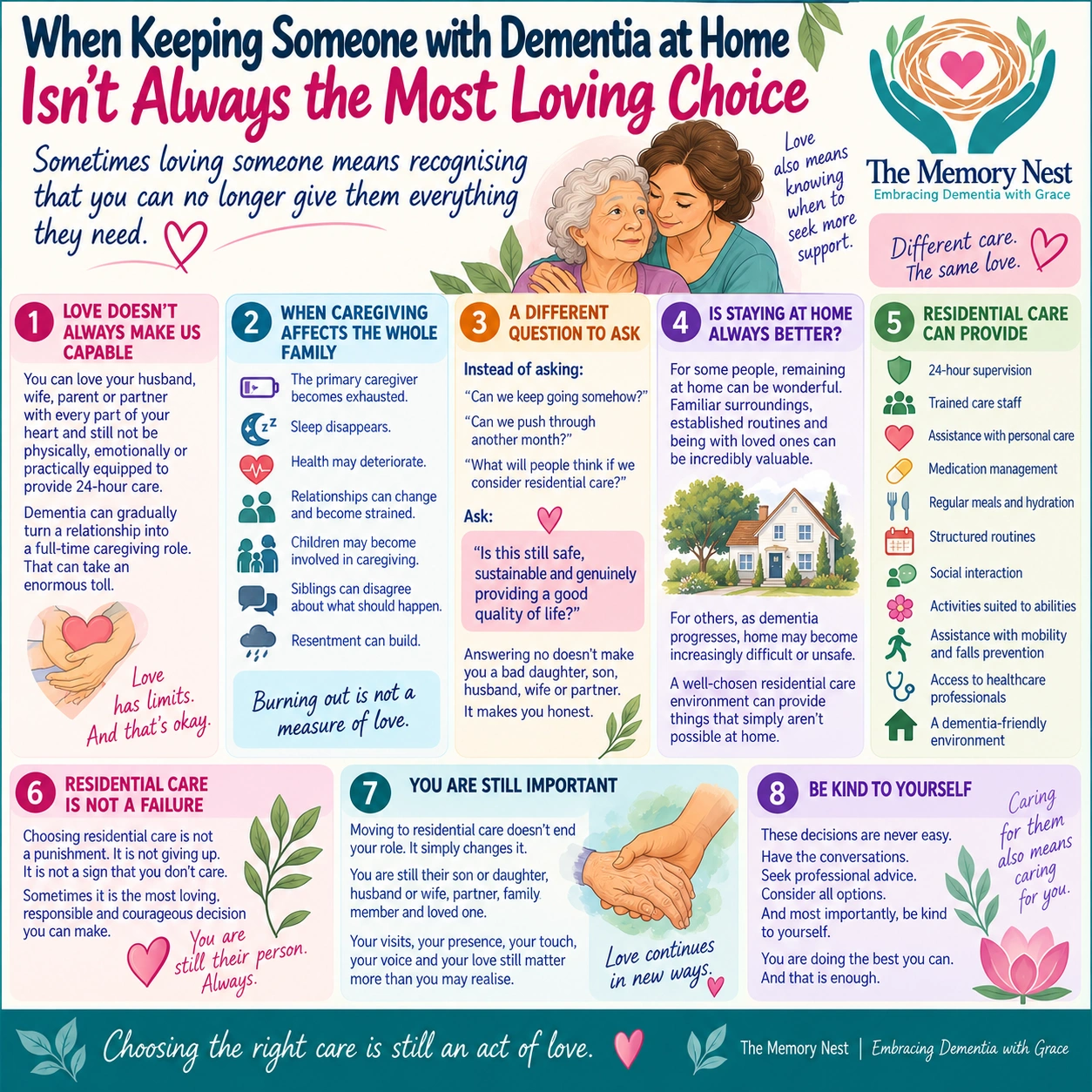
Sometimes Love Means Asking a Different Question
When someone you love is living with dementia, the instinct to keep them at home can be incredibly strong.
Home represents familiarity, memories, comfort and independence. You may feel that caring for them yourself is the ultimate expression love.
But dementia can gradually change what a person needs and what a family is realistically able to provide.
Sometimes, loving someone means recognising when you can no longer give them everything the need on your own.
Love Doesn't Always Make Us Capable of 24-Hour Care
You can love your parent, partner, husband or wife deeply and still not be physically, emotionally or practically equipped to provide round-the-clock care.
As dementia progresses, caregiving may become a full-time responsibilty.
You may find yourseld managing:
Medications
Personal care
Meals and hydration
Toileting
Mobility
Safety
Appointments
Behavioural changes
Household responsibilities
Over time, this can take an enormous physical and emotional toll.
Needing help does not mean you love them any less.
When Caregiving Affects the Whole Family
Dementia doesn't only affect the person living with the condition.
The primary caregiver may become exhausted. Sleep may disappear. Relationships can become strained and other family members may become involved in ways they never expected.
Siblings may disagree about what should happen. Children may become caregivers themselves. Resentment, guilt and worry can quietly build.
These experiences don't mean your family has failed.
Ask a Different Question
Instead of asking: "How can we keep going?" Or "Can we push through another month?"
Consider asking: "Is this still safe, sustainable and genuinely providing a good quality of life?"
That question isn't about giving up.
It's about making sure the person you love and the people caring for them are receiving the support they need.
Is Staying at Home Always Better?
For some people, staying at home can be wonderful.
Familiar surroundings, established routines and the presence needs that become increasingly difficult or unsafe to manage at home.
A well-chosen residential care environment may provide support that simply isn't possible in a family home.
This can include:
24-hour supervision
Trained care staff
Assistance with personal care
Medication management
Regular meals and hydration
Structured routines
Social interaction
Activities suited to individual abilities
Mobility and falls support
Access to healthcare professionals
A dementia-friendly environment
Residential Care Is Not a Failure
Choosing residential care is not a punishment.
It is not giving up.
Its is not proof that you don't care.
Sometimes, it can be the most responsible and compassionate decision a family can make.
Different care. The same love.
Moving someone into residential care doesn't mean your role disappears.
You are still their daughter, son, husband, wife, partner, family member and love one.
Your visits, your presence, your voice, your touch and your connection can continue to matter deeply.
Be Kind to Yourself
These decisions are never easy.
Talk with family members. Seek professional advice. Consider the available options carefully.
And most importantly, remember that caring for someone also means recognising your own limits.
You are doing the best you can. And that is enough.